

Tactile Wayfinding Transfer Study
- Team
- Nima FatemiMatthew GrahamAlexis LorAnn McLaughlin (Faculty Mentor)Bryan Bell (Head of Design Team)
- Year
- 2025
On this page
Snapshot
Problem to solve
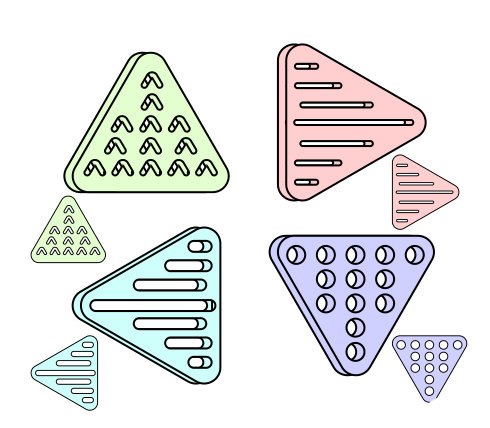
Before deploying cane-detectable floor mats as a “tactile vocabulary,” we needed evidence that people can learn pattern meanings through small training tiles, then reliably recognize those meanings later using a cane on full-scale mats, and we needed to know what drives failures.
How we tested it
In-person within-subject pilot (N = 15, blindfolded). Participants learned 3 tactile patterns by hand, completed a short recall and distraction step, then identified the same patterns on full-size floor mats using a cane. We built a Python-guided workflow to standardize timing, randomize pattern-to-meaning pairings, and prevent missing data.
What we found
- Strong transfer: cane-based identification reached 89% accuracy vs 33% chance.
- Onboarding quality predicts outcomes: confusion during handheld learning predicted worse cane performance later.
- Design tweaks were not the main lever: pattern type and mat location were not reliable drivers, and individual differences explained more variance.
- Perceived ease was misleading: what felt “easy” did not match actual accuracy.
Why this matters for products
This supports training tiles as a practical onboarding path, but it also flags a risk: if early learning is shaky, downstream navigation breaks. The product move is to treat onboarding like a safety check, not a tutorial. Add a quick mastery gate, detect confusion early, and give corrective practice before users rely on the system in the real world. Also, do not over-invest in fine-grained pattern geometry without evidence. Focus on training quality, consistency, and support for user differences.
- Learn by handSmall training tiles
- Mastery gateA quick check that detects confusion earlyConfused? Corrective practice, then check again
- Use by caneFull-scale floor mats in the real world
Project overview
A College of Design team created new cane-detectable floor mats for the Governor Morehead School and proposed smaller “training tiles” to teach pattern meanings and act as trail markers. Our team ran a controlled pilot study to test whether tactile patterns learned by hand transfer to cane-based identification on full-scale mats, and what drives errors. In a within-subjects protocol (N=15, blindfolded), participants reached 89% cane-mat identification accuracy (vs 33% chance). Early confusion during hand-learning predicted worse cane performance, while mat type and location were not reliable drivers.
My role
UX Researcher
Co-designed and executed the study, from framing the research question and protocol to analysis and design implications for tactile wayfinding onboarding.
Problem
Tactile cues in real environments are often inconsistent or incidental, which makes it hard to learn and reliably use them for navigation. Before deploying a tactile wayfinding “vocabulary,” we need evidence that users can learn pattern meanings and recognize them later through a cane under non-visual conditions.
Goal
Evaluate learnability, short-term retention, and hand-to-cane transfer of tactile patterns, and identify which learning signals predict recognition errors so we can inform onboarding and mat design decisions.
Responsibilities
- Aligned with stakeholders on the research question and success criteria for a learnable tactile pattern system
- Conducted literature review on tactile perception, cane sensing, working memory load, and non-visual navigation
- Built a task analysis and end-to-end experimental flow under real session time constraints
- Implemented a Python-guided workflow to randomize trials, standardize timing, and log data with no missing fields
- Ran the study sessions, including cane technique tutorial, handheld learning, distraction task, and cane identification
- Analyzed results (one-sample t-test vs chance, ANOVA, mixed-effects modeling) and synthesized key drivers
- Translated findings into product-facing implications, especially onboarding checks and training quality safeguards
Research Setup
A controlled, single-session human factors study designed to test whether tactile patterns learned by hand transfer to cane-based recognition of floor mats. The study evaluated learnability, short-term retention, and sources of error relevant to onboarding tactile wayfinding systems.
Research Questions
- Does learning tactile patterns by hand improve later recognition using a cane on full-scale floor mats?
- How accurately can participants identify tactile patterns using a cane after brief training?
- Does confusion during initial learning predict later errors during cane-based navigation?
- Are certain pattern types or spatial locations inherently easier to recognize, or do individual differences dominate performance?
Study Design
Independent variables
- Learning phase: handheld tactile exploration
- Pattern type: three distinct tactile patterns
- Spatial location: three assigned locations
- Self-reported learning confusion
Key dependent variables
- Cane-based pattern identification accuracy
- Handheld recall accuracy
- Error patterns during cane use
- In person, one session, in a controlled indoor setting
- Within-subject tactile classification task: everyone completed handheld learning and cane-based identification
Participants
- N = 15 university students
- Ages 18–25
- Normal or corrected vision; blindfolded during all tasks
- Selected to evaluate baseline learnability and transfer before testing with visually impaired users
Procedure
- Intro and cane tutorialGrip, sweep and tip contact
- by handHandheld learningThree small tactile mats by fingertip, each paired with a location label
- by handHandheld recallIdentify the learned patterns without visual input
- Distraction taskA short spatial task that loads working memory
- by caneCane-based identificationFull-scale floor mats, explored with a cane
- Post-task surveyPerceived confusion and difficulty
Data Collection Tooling
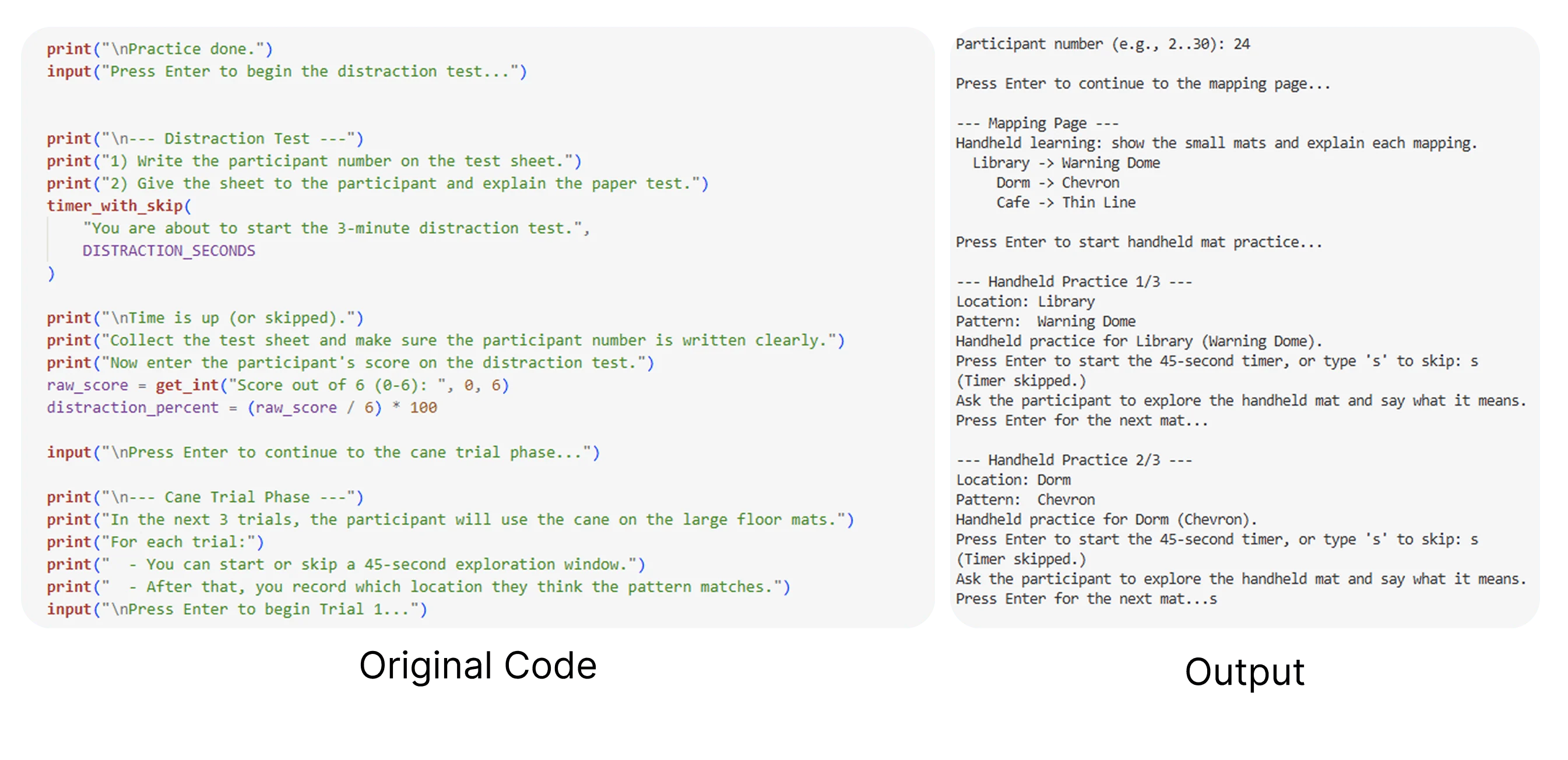
To ensure consistency and eliminate missing data, we built a custom Python data collection tool that:
- Enforced uniform timing with built-in timers for each phase
- Prompted structured data entry at the end of each step and trial
- Logged all responses in real time to prevent missing fields
- Automatically randomized the handheld pattern-to-meaning pairings across participants (3 patterns × 3 meanings)
- Why this mattered: randomization reduced learning bias, so results were less likely to be driven by a specific label, location meaning, or fixed pairing and more likely to reflect true tactile learning and transfer
Measures
Behavioral
- Cane-based identification accuracy
- Handheld recall accuracy
Self-reports
- Learning confusion during handheld training
- Perceived difficulty during cane use
My Role
- Co-designed the research questions and experimental protocol
- Conducted literature review on tactile perception, cane sensing, and non-visual navigation
- Built the end-to-end task flow under real session constraints
- Developed the Python-based data collection workflow
- Ran study sessions and ensured protocol consistency
- Analyzed results and synthesized findings into design implications for tactile wayfinding onboarding
Results
We analyzed behavioral data from a controlled, within-subject tactile navigation study to evaluate how well tactile patterns learned by hand transferred to cane-based identification, and what factors predicted errors.
- Confusion during handheld learningPredicted worse cane performance
- Confusion during the cane taskDid not reliably predict performance
- Pattern typeNot statistically reliable
- Mat locationNot statistically reliable
- Which pattern felt easiestDid not correlate with accuracy
Cane Identification Performance
How accurately participants identified floor mats using a cane.
Key Patterns
Participants identified cane-detectable floor mats with 89% accuracy, far above chance level (33%). This indicates strong transfer from handheld tactile learning to cane-based recognition, even after a short distraction task.
Takeaway
Handheld tactile training is an effective onboarding mechanism for cane-based wayfinding systems.
Learning Quality Effects
How initial learning influenced later cane performance.
Key Patterns
Participants who reported confusion during the handheld learning phase performed significantly worse during cane-based identification. Confusion reported during the cane task itself did not reliably predict performance.
Takeaway
Early learning quality is a critical design lever. If users are confused during onboarding, performance breaks downstream.
Pattern Type and Location
Whether certain patterns or spatial placements were easier to recognize.
Key Patterns
Differences between tactile pattern types and assigned locations were not statistically reliable. Performance variance was better explained by individual differences than by specific pattern designs or layout.
Takeaway
Pattern learnability depends more on training and user differences than on fine-grained pattern geometry.
Subjective Ease vs Actual Performance
How perceived difficulty related to accuracy.
Key Patterns
Participants’ self-reported judgments about which patterns felt “easiest” to learn did not correlate with their actual cane-based accuracy.
Takeaway
Design decisions should rely on performance data, not perceived intuitiveness.
Short-Term Retention
Whether learning survived brief interruptions.
Key Patterns
Participants retained pattern-to-meaning mappings after a short distraction period, indicating stable short-term memory for tactile cues.
Takeaway
Tactile pattern learning can support real navigation flows where users learn, pause, and then move through space.