
AI Text Detection Study
- Team
- Nima FatemiJackson BurnsLeah CresslerDr. Daniel Gruehn (Faculty Mentor)
- Year
- 2024
On this page
Snapshot
Problem to solve
Students use AI writing tools constantly, but we do not know if they can actually spot AI-written text, or how confidence and trust shape those judgments. That gap matters for AI literacy, academic integrity, and any product that relies on users to assess content credibility.
How we tested it
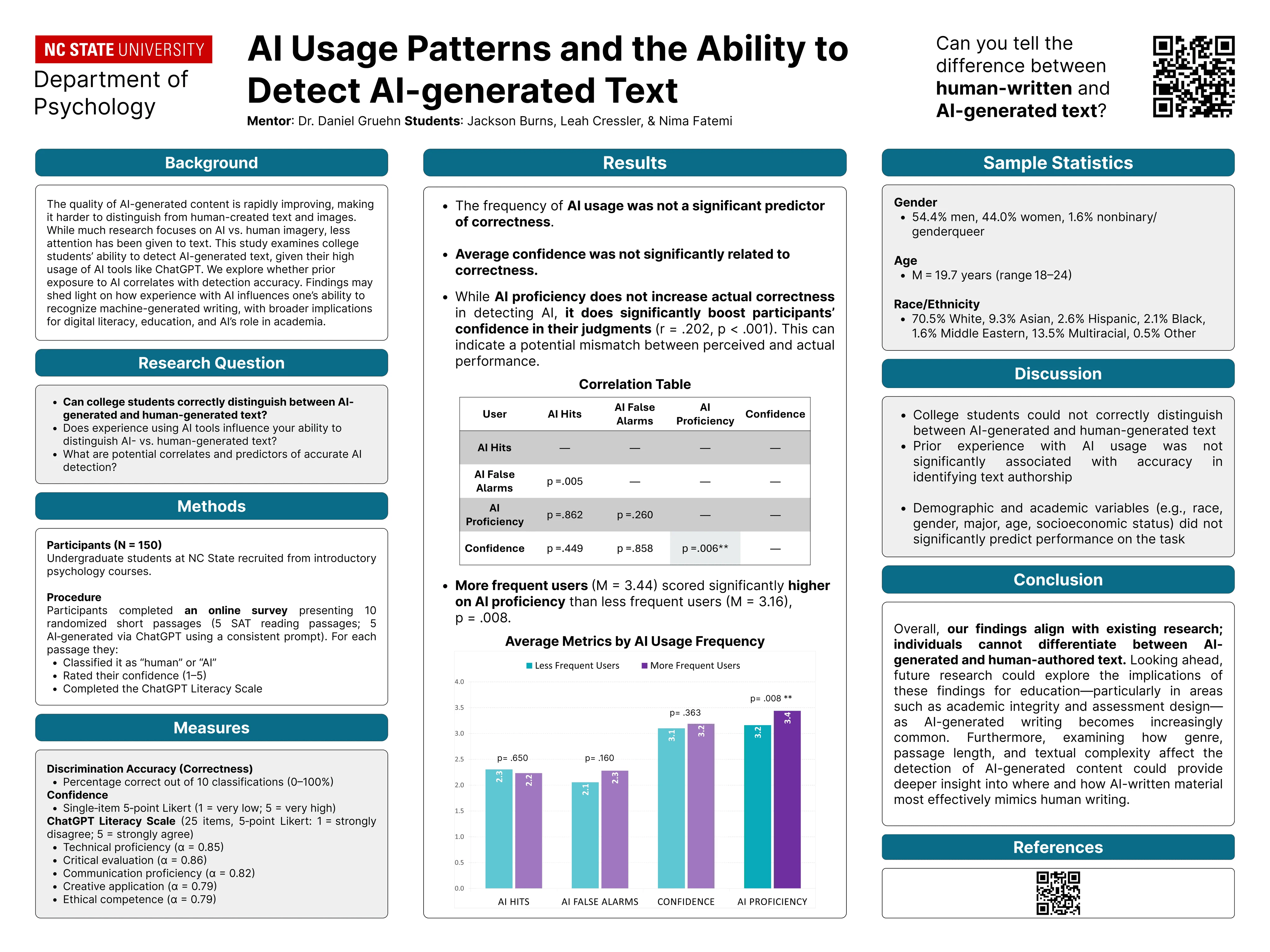
Online within-subject study with 150 first-year undergrads. Each person classified 10 passages (5 human SAT, 5 ChatGPT from matched prompts), then rated confidence (1 to 5), trust in the passage, plus a ChatGPT literacy and usage survey.
What we found
- Detection was weak: students were only slightly above chance at telling AI vs human text.
- Confidence was not a reliability signal: how sure they felt did not track whether they were right.
- Skill raised confidence, not accuracy: higher AI proficiency increased confidence, but did not improve detection.
- Confidence and trust moved in opposite directions: when students felt more sure about authorship, they tended to trust the content less.
Why this matters for products
If your product depends on users to judge authenticity or credibility, you are exposed. You cannot “educate your way out” by targeting power users, because higher proficiency can create overconfidence without better judgment. The safer product move is to reduce reliance on human detection and design explicit support for evaluation: clear provenance cues, lightweight verification affordances, and UX that treats confidence as a user state to manage, not as evidence of correctness.
Project overview
College students increasingly rely on AI tools like ChatGPT, yet it remains unclear how well they can detect AI-generated writing or how their trust in AI content shifts with confidence and proficiency. We ran a 150-participant behavioral study to test detection accuracy, confidence, and trust patterns when students classify AI vs. human text. Our findings reveal a consistent confidence–accuracy gap, as well as a negative correlation between confidence and trust in AI-written content.
My role
Lead UX Researcher
Designed and executed the full behavioral study, from framing the research questions to developing measures, running analysis, and synthesizing insights for academic and HAI applications.
Problem
Students frequently interact with AI-generated text, but their ability to recognize it, their confidence in these judgments, and their trust toward AI content are poorly understood. This creates risks for digital literacy, academic integrity, and over-reliance on AI systems.
Goal
Measure how accurately students detect AI-generated writing, and identify the psychological factors that influence confidence, AI trust, and miscalibrated judgments.
Responsibilities
- Designed research protocol, measures, and classification tasks
- Programmed and deployed the online experiment
- Ran statistical analysis and modeled accuracy–confidence–trust relationships
- Synthesized findings into actionable insights for AI literacy and HAI design
- Co-authored poster and presented results at SNCURCS
Research Setup
A single-session, online behavioral study where each participant classified a mix of AI-generated and human-written passages, rated their confidence, their trust in the text, and completed an AI literacy survey.
Research Questions
- Can first-year college students reliably distinguish AI-generated text from human-written text in short reading passages?
- Does frequency of AI tool use or self-reported AI proficiency improve detection accuracy?
- How are people’s confidence in their judgments and their trust in AI-generated text related to actual performance?
- Which individual factors (for example AI proficiency, confidence, trust) are most predictive of accurate AI detection?
Study Design
Independent variables
- Passage type: AI-generated vs human-written
- AI usage frequency
- AI proficiency (subscales of the ChatGPT Literacy Scale)
Key dependent variables
- Classification accuracy
- Confidence in each judgment
- Trust in the text
- Remote survey-based experiment, completed on participants’ own laptops or phones
- Within-subject classification task: every student saw both AI and human passages
Participants
- N = 150 first-year undergraduates from introductory psychology courses at NC State.
- Age: 18–24 years, mean ≈ 19.7.
- Mixed gender and race/ethnicity, roughly representative of the local student body.
- The sample intentionally focused on heavy AI adopters in an academic context, since these students are most likely to interact with tools like ChatGPT in their coursework.
Experimental Procedure
- Intro and consentBriefed that they would evaluate short passages and answer questions about AI usage
- Classification task10 randomized passages, each labeled and rated
- AI literacy and trust surveyChatGPT Literacy Scale (25 items, 5 subscales), usage and trust
- DebriefPurpose of the study and the presence of AI passages
5 SAT reading passages, human-written5 passages generated by ChatGPT from matched prompts
Measures
Behavioral
- Detection accuracy
Percentage of correct classifications across the 10 passages (0–100 percent). - Confidence per judgment
Single-item 5-point rating from “very low” to “very high” for each passage. - Trust in the text
Likert-style items on how much they trust that the given text is accurate and representative of the truth.
Self-reports
- ChatGPT Literacy Scale (25 items) with five subscales: technical proficiency, critical evaluation, communication proficiency, creative application, and ethical competence. All showed good internal reliability.
- AI usage frequency
How often do participants use tools like ChatGPT in a typical week? - Trust in AI text
Likert-style items on how much they trust AI-generated writing in academic work and study tasks.
My Role
- Co-developed the research questions with the faculty mentor, framing the study around detection, confidence, and trust in AI-generated text.
- Designed the classification task and wrote the prompts used to generate AI passages so they matched the style and difficulty of human SAT texts.
- Selected and configured survey measures, including the ChatGPT Literacy Scale and trust items.
- Cleaned and analyzed the data, focusing on accuracy, confidence, proficiency, and trust relationships.
- Led the synthesis of findings into a clear story that highlights the confidence–accuracy–trust gap and its implications for digital literacy and assessment design.
- Designed the poster layout and presented the work at the State of North Carolina Undergraduate Research and Creativity Symposium.
Results
We analyzed behavioral data from 150 students to see how well they detect AI-generated text, how confident they feel about those judgments, and how much they trust what they read.
Detection Performance
How accurately students could tell AI text from human writing.
Key Patterns
Overall, students were only slightly above chance at telling AI-generated text from human-written passages. AI usage frequency did not improve correctness, and demographic or academic variables (gender, race, major, age, socioeconomic status) showed no clear relationship with performance.
Takeaway
Baseline detection is weak, and no obvious user segment is naturally better at spotting AI text.
Confidence Calibration
How students’ confidence lined up with actual performance.
Key Patterns
Confidence did not predict correctness. Highly confident judgments were often wrong, and low-confidence judgments were sometimes right. Higher AI proficiency increased confidence, but did not improve detection accuracy.
Takeaway
Users can feel very sure and still be wrong, especially as their AI skill grows.
AI Usage and Proficiency
How using AI tools relates to skill and behavior.
Key Patterns
Frequent AI users showed significantly higher AI proficiency scores, but they were not better at detecting AI text than infrequent users.
Takeaway
More hands-on AI experience creates power users, not necessarily better critical judges.
Confidence and Trust in Each Passage
How confidence in a judgment relates to trust in that specific text.
Key Patterns
After each passage, students rated how much they trusted the text to be accurate. Across passages, higher confidence in one’s classification was linked to lower trust in the passage itself. When students felt sure about whether something was AI or human, they tended to trust its content less.
Takeaway
As confidence in “who wrote this” goes up, trust in “is this true” can go down.
Research poster