

Nima Fatemi
Matthew Graham
Alexis Lor
Ann McLaughlin (Faculty Mentor)
Bryan Bell (Head of Design Team)
Snapshot
Problem to solve:
Before deploying cane-detectable floor mats as a “tactile vocabulary,” we needed evidence that people can learn pattern meanings through small training tiles, then reliably recognize those meanings later using a cane on full-scale mats, and we needed to know what drives failures.
How we tested it:
In-person within-subject pilot (N = 15, blindfolded). Participants learned 3 tactile patterns by hand, completed a short recall and distraction step, then identified the same patterns on full-size floor mats using a cane. We built a Python-guided workflow to standardize timing, randomize pattern-to-meaning pairings, and prevent missing data.
What we found:
Strong transfer: cane-based identification reached 89% accuracy vs 33% chance.
Onboarding quality predicts outcomes: confusion during handheld learning predicted worse cane performance later.
Design tweaks were not the main lever: pattern type and mat location were not reliable drivers, and individual differences explained more variance.
Perceived ease was misleading: what felt “easy” did not match actual accuracy.
Why this matters for products:
This supports training tiles as a practical onboarding path, but it also flags a risk: if early learning is shaky, downstream navigation breaks. The product move is to treat onboarding like a safety check, not a tutorial. Add a quick mastery gate, detect confusion early, and give corrective practice before users rely on the system in the real world. Also, do not over-invest in fine-grained pattern geometry without evidence. Focus on training quality, consistency, and support for user differences.
Project overview
Tactile Wayfinding Transfer Study
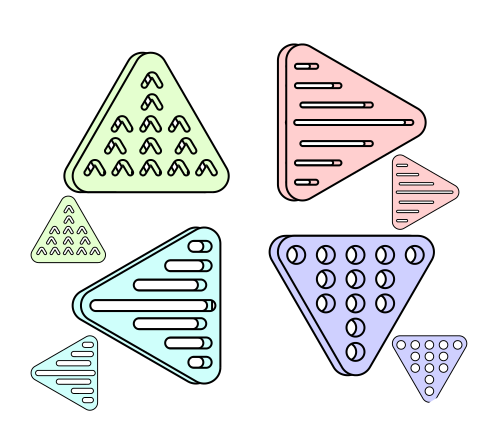
A College of Design team created new cane-detectable floor mats for the Governor Morehead School and proposed smaller “training tiles” to teach pattern meanings and act as trail markers. Our team ran a controlled pilot study to test whether tactile patterns learned by hand transfer to cane-based identification on full-scale mats, and what drives errors. In a within-subjects protocol (N=15, blindfolded), participants reached 89% cane-mat identification accuracy (vs 33% chance). Early confusion during hand-learning predicted worse cane performance, while mat type and location were not reliable drivers.
My role:
UX Researcher
Co-designed and executed the study, from framing the research question and protocol to analysis and design implications for tactile wayfinding onboarding.
Problem:
Tactile cues in real environments are often inconsistent or incidental, which makes it hard to learn and reliably use them for navigation. Before deploying a tactile wayfinding “vocabulary,” we need evidence that users can learn pattern meanings and recognize them later through a cane under non-visual conditions.
Goal:
Evaluate learnability, short-term retention, and hand-to-cane transfer of tactile patterns, and identify which learning signals predict recognition errors so we can inform onboarding and mat design decisions.
Responsibilities:
• Aligned with stakeholders on the research question and success criteria for a learnable tactile pattern system
• Conducted literature review on tactile perception, cane sensing, working memory load, and non-visual navigation
• Built a task analysis and end-to-end experimental flow under real session time constraints
• Implemented a Python-guided workflow to randomize trials, standardize timing, and log data with no missing fields
• Ran the study sessions, including cane technique tutorial, handheld learning, distraction task, and cane identification
• Analyzed results (one-sample t-test vs chance, ANOVA, mixed-effects modeling) and synthesized key drivers
• Translated findings into product-facing implications, especially onboarding checks and training quality safeguards
Research Setup
A controlled, single-session human factors study designed to test whether tactile patterns learned by hand transfer to cane-based recognition of floor mats. The study evaluated learnability, short-term retention, and sources of error relevant to onboarding tactile wayfinding systems.
Research Questions
Does learning tactile patterns by hand improve later recognition using a cane on full-scale floor mats?
How accurately can participants identify tactile patterns using a cane after brief training?
Does confusion during initial learning predict later errors during cane-based navigation?
Are certain pattern types or spatial locations inherently easier to recognize, or do individual differences dominate performance?
Study Design
Format
In-person, single-session experimental study conducted in a controlled indoor setting.
Task type
Within-subject tactile classification task. All participants completed handheld learning and cane-based identification, allowing direct comparison at the individual level.
Independent variables (high level)
Learning phase: handheld tactile exploration
Pattern type: three distinct tactile patterns
Spatial location: three assigned locations
Self-reported learning confusion
Key dependent variables
Cane-based pattern identification accuracy
Handheld recall accuracy
Error patterns during cane use
Participants
N = 15 university students
Ages 18–25
Normal or corrected vision; blindfolded during all tasks
Selected to evaluate baseline learnability and transfer before testing with visually impaired users
Procedure
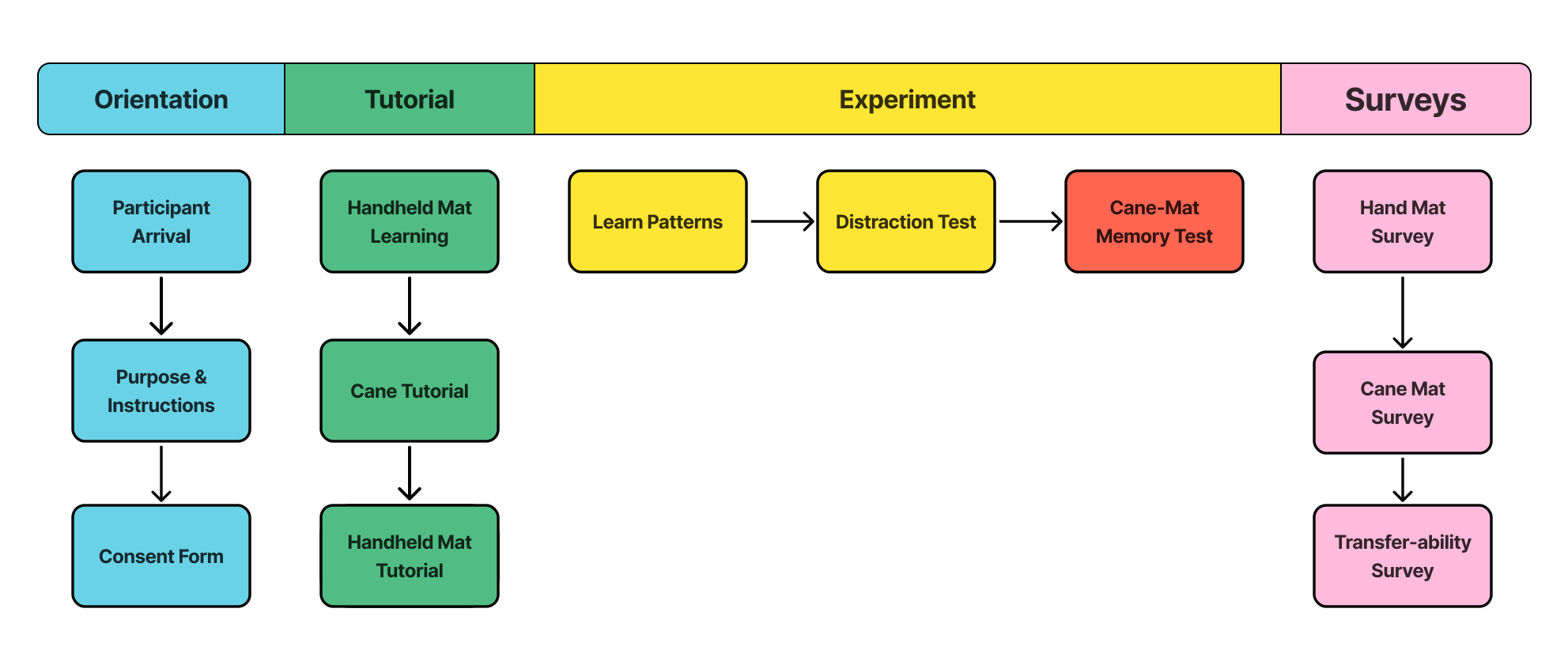
1 – Intro and cane tutorial
Participants were briefed on the task and trained on basic long-cane technique, including grip, sweep, and tip contact.
2 – Handheld learning phase
Participants explored three small tactile mats by fingertip, each paired with a location label. Learning time was capped to ensure consistent exposure.
3 – Handheld recall
Participants identified the learned patterns without visual input to assess immediate learning quality.
4 – Distraction task
A short spatial task was used to load working memory and simulate real navigation interruptions.
5 – Cane-based identification
Participants used a cane to explore full-scale floor mats and verbally identified the associated locations.
6 – Post-task survey
Participants reported perceived confusion and difficulty during learning and cane use.
Data Collection Tooling
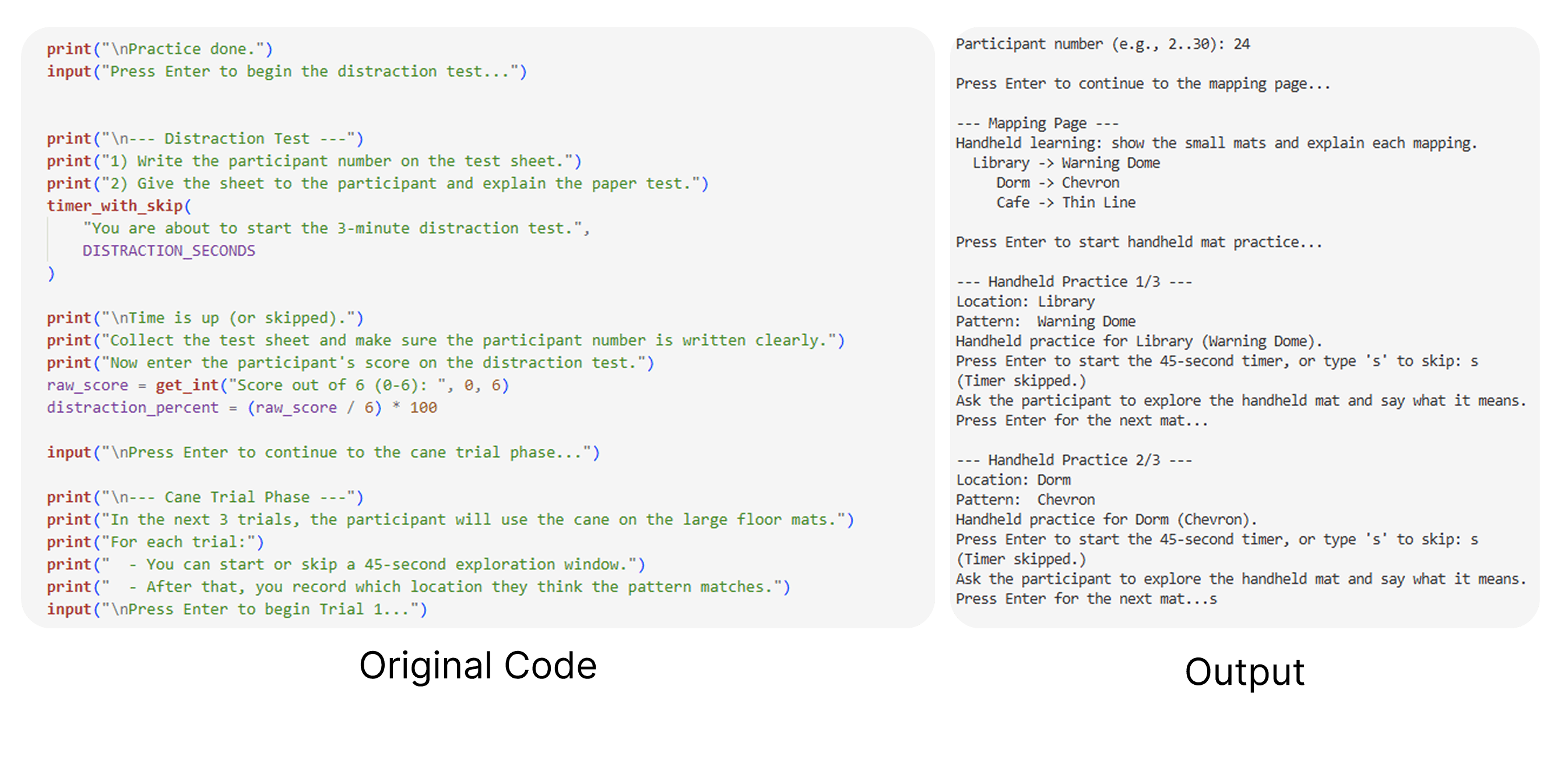
To ensure consistency and eliminate missing data, we built a custom Python data collection tool that:
Enforced uniform timing with built-in timers for each phase
Prompted structured data entry at the end of each step and trial
Logged all responses in real time to prevent missing fields
Automatically randomized the handheld pattern-to-meaning pairings across participants (3 patterns × 3 meanings)
Why this mattered: randomization reduced learning bias, so results were less likely to be driven by a specific label, location meaning, or fixed pairing and more likely to reflect true tactile learning and transfer
Measures
Behavioral
Cane-based identification accuracy
Handheld recall accuracy
Self-reports
Learning confusion during handheld training
Perceived difficulty during cane use
My Role
Co-designed the research questions and experimental protocol
Conducted literature review on tactile perception, cane sensing, and non-visual navigation
Built the end-to-end task flow under real session constraints
Developed the Python-based data collection workflow
Ran study sessions and ensured protocol consistency
Analyzed results and synthesized findings into design implications for tactile wayfinding onboarding
Results
We analyzed behavioral data from a controlled, within-subject tactile navigation study to evaluate how well tactile patterns learned by hand transferred to cane-based identification, and what factors predicted errors.
Cane Identification
Performance
How accurately participants identified floor mats using a cane.
Key Patterns
Participants identified cane-detectable floor mats with 89% accuracy, far above chance level (33%). This indicates strong transfer from handheld tactile learning to cane-based recognition, even after a short distraction task.
Takeaway
Handheld tactile training is an effective onboarding mechanism for cane-based wayfinding systems.
Learning Quality Effects
How initial learning influenced later cane performance.
Key Patterns
Participants who reported confusion during the handheld learning phase performed significantly worse during cane-based identification. Confusion reported during the cane task itself did not reliably predict performance.
Takeaway
Early learning quality is a critical design lever. If users are confused during onboarding, performance breaks downstream.
Pattern Type and Location
Whether certain patterns or spatial placements were easier to recognize.
Key Patterns
Differences between tactile pattern types and assigned locations were not statistically reliable. Performance variance was better explained by individual differences than by specific pattern designs or layout.
Takeaway
Pattern learnability depends more on training and user differences than on fine-grained pattern geometry.
Subjective Ease vs Actual Performance
How perceived difficulty related to accuracy.
Key Patterns
Participants’ self-reported judgments about which patterns felt “easiest” to learn did not correlate with their actual cane-based accuracy.
Takeaway
Design decisions should rely on performance data, not perceived intuitiveness.
Short-Term Retention
Whether learning survived brief interruptions.
Key Patterns
Participants retained pattern-to-meaning mappings after a short distraction period, indicating stable short-term memory for tactile cues.
Takeaway
Tactile pattern learning can support real navigation flows where users learn, pause, and then move through space.